
By Yiqing Wang/WHRO
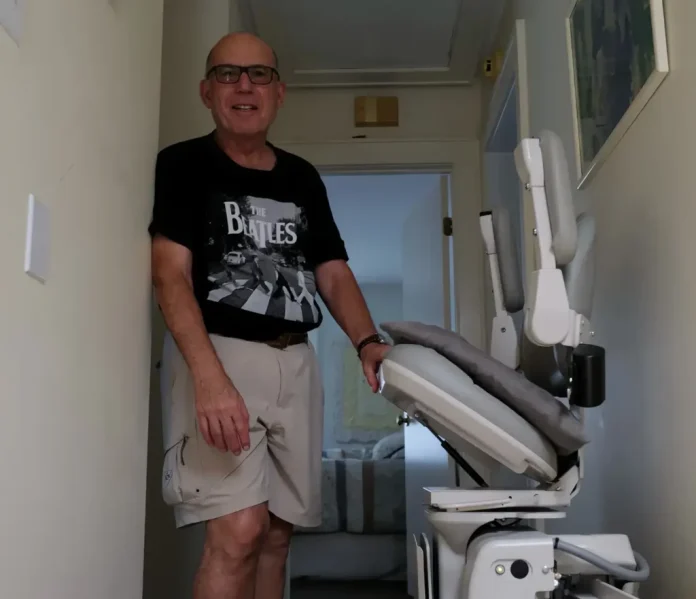
Howard Weinberg keeps his Parkinson’s medication in a small container attached to his keychain, so he always has it wherever he goes.
The retired doctor from Virginia Beach has to take the medication every six hours, at 1 o’clock and 7 o’clock, day and night.
For him, that schedule is not optional.
“It should be within 15 minutes of when it’s due. And if you don’t, then you lose mobility, you get so many complications,” Weinberg said.
Those complications can include falls, swallowing problems and urinary tract infections.
But Weinberg said maintaining that routine to prevent those complications can be tough when Parkinson’s patients end up in the hospital – something that’s not uncommon.
National data shows about 1.1 million Americans are living with Parkinson’s disease.
One in three are hospitalized each year, and one in six have avoidable complications during the stay because they do not receive their medications on time.
During the day, he said, hospital medication rounds often happen every four hours at standard times, which often doesn’t line up with a Parkinson’s patient regimen.
Weinberg has seen Parkinson’s disease from several sides. He spent decades as a physician. His mother was diagnosed with Parkinson’s in the early 90’s. His sister was diagnosed with the disease eight years ago.
Then, after his wife died in 2024, Weinberg was diagnosed with Parkinson’s himself.
“I’ve known about Parkinson’s for 55 years, but it’s only in the last year when I become worse that I’m understanding what it’s like to be patient with Parkinson’s,” Weinberg said. “It’s a whole new world until you experience it yourself.”

Weinberg now volunteers as an ambassador for the Parkinson’s Foundation, a national organization that supports people living with the disease and advocates for better care.
He gives presentations on hospital safety and encourages patients to prepare medication lists before a hospital stay.
Because hospital medication rounds often do not match patients’ individual dosing schedules, Weinberg is pushing hospitals to establish clearer protocols to make sure Parkinson’s patients receive their medication on time.
“I would love them to [have] at least a partnership, so maybe the nurse knows they’re in the room and in a place, and it was 1am and the nurse hasn’t come in to give you, you take the pills that are in the room, and then they see that you took them,” Weinberg said.
Annie Brooks, who works on hospital care for the foundation, said Parkinson’s medications should ideally be given within 15 minutes before or after a patient’s specific scheduled time.
“The time sensitivity of Parkinson’s medications is similar to the time sensitivity of diabetes medications for people with diabetes,” Brooks said.
Brooks said federal rules allow hospitals to let some patients or caregivers administer their own medication, as long as the hospital has a written policy and confirms they can do it safely. But she said many hospitals are still hesitant.
“It means you have to have some processes set, some expectations set,” Brooks said. “It’s not something that a lot of hospitals do, but it is absolutely something that we hear from the Parkinson’s community is a desired protocol.”
The Parkinson’s Foundation is working with about 50 health systems nationwide through its Hospital Care Learning Collaborative.
The effort focuses on medication timing, avoiding drugs that can worsen Parkinson’s symptoms, helping patients move during hospital stays and screening for swallowing problems.

Virginia Commonwealth University Health is one of the participating systems.
Leslie Cloud is a professor of neurology in the VCU School of Medicine and the medical director of the Parkinson’s Foundation Center of Excellence at VCU.
She said the collaboration’s priorities start with making sure hospitalized Parkinson’s patients get the exact medications they take at home, without substitutions, and get them on time.
“No substitutions, like the exact same ones, and exactly on time — not plus or minus two hours, but on time, plus or minus 15 minutes,” Cloud said.
Cloud said getting medication within that 15-minute window is one of the biggest challenges for hospitals because medication delivery depends on staffing and nursing workflow.
She said VCU is looking at a 30-minute medication window as a more realistic first step toward the 15-minute goal.
The health system is also working on changes to its electronic medical record system to flag Parkinson’s patients and warn providers about drugs that can worsen their symptoms.
Cloud said allowing some patients to use their own medication can help, especially because newer Parkinson’s drugs are not always available in hospital pharmacies.
“Our patients are really good about taking their medications on time because they know what happens when they don’t,” Cloud said. “They’re more likely to get the medicine in that plus or minus 15-minute window if they have control over it themselves.”
But Cloud said self-administration is not possible for every patient, including people with dementia or those who do not have a caregiver who can help manage medication safely.
For Weinberg, the goal is to make those steps part of routine hospital care before a Parkinson’s patient arrives.
He said he has been advocating for local health care systems in Hampton Roads to adopt similar protocols, but he says he’s gotten nowhere.
Sentara, one of Virginia’s largest health systems, declined an interview request for this story.
Riverside Health, which operates a Parkinson’s Disease & Movement Disorders Program, had not responded to an interview request by publication time.
Weinberg said hospitals already have protocols for conditions such as chest pain or stroke symptoms. He wants Parkinson’s care to be treated with the same urgency.
“I’d like to see every hospital in the United States and the world put in a patient’s protocol for Parkinson’s,” Weinberg said.