
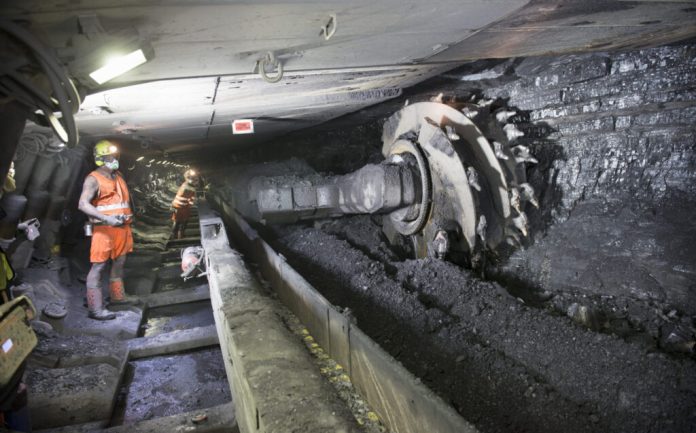
With new research showing that black lung disease among Appalachian coal miners has reached an almost 50-year high, advocates are demanding federal regulations be enforced.
The data published in the American Journal of Respiratory and Critical Care Medicine is also part of a peer-reviewed research letter from the National Institute for Occupational Safety and Health (NIOSH).
Congress previously passed regulations meant to limit miners’ exposure to coal dust, which causes the incurable lung disease.
Typical mitigation measures include spraying drilling machinery with water to suppress dust particles, use of personal protective equipment like respirators and inspections by the Mine Safety and Health Administration.
The last time black lung cases were at current rates was in the 1970s, according to the NIOSH letter. While black lung disease dipped in the late 1990s, cases in workers who have spent 25 years or more in mines have climbed since 2000. A third of miners who have spent 25 years or more underground now have the disease.
There has also been an increase in miners with less experience, which “indicates that the burden of the disease is affecting younger miners and not confined to the most experienced workers,” researchers wrote.
“This tells you that companies aren’t doing what they’re supposed to be doing,” said Vonda Robinson, vice president of the National Black Lung Association.
The Southwest Virginia resident is the wife of longtime coal miner John Robinson. Since his black lung diagnosis a little over a decade ago, he’s helped her work for laws and regulations to improve safety and benefits.
This entails lots of conversations with federal lawmakers in multiple states and political activism. Last year, they joined a multi-state coalition of miners in Washington D.C., to protest a court order blocking a President Joe Biden-era safety rule.
Under Biden’s presidency, the Mine Safety and Health Administration created stricter safety standards by lowering exposure limits for workers — a critical move, John Robinson said, as miners over time have needed to drill deeper and deeper into rock to reach coal seams.
“It took us two and a half years to get to the coal seam,” he said. “We basically breathed rock for two and a half years.”
That means exposure not to coal at first, but also to silica dust from cutting through the rocks in the area.
Quenton King, government affairs specialist with Appalachian Voices, said the mining industry suspects silica dust plays a role in continued black lung cases.
The Biden-era rule was supposed to take effect in April 2025, but cuts to federal workers contributed to a delayed enforcement timeline before ultimately winding up in court. President Donald Trump’s administration did not defend the rule in court and petitioned the court to block labor unions and the Black Lung Association from intervening in the case.
National Mining Association spokesman Conor Bernstein told The New York Times late last year that the organization is “absolutely supportive of the new lower levels” but did not respond to inquiry from the Virginia Mercury by the time of this publication.
While the litigated rule would require operators to reduce silica concentration through a variety of measures beyond personal protective equipment, the association suggests PPE should be sufficient.
King said that miners struggle to keep their respirators on at all times because of communication challenges in noisy mines as drilling machines are running. Still, he added, “If you aren’t trying to have a dust-free environment, respirators will clog up multiple times in a shift.”
Appalachian Voices views respirators as the back up to back up measures and sees the Biden rule as a more solid frontline defense.
Just before pulling back on the Biden-era rule, Trump’s 2025 State of the Union address to Congress focused on his goal of ramping up coal production for energy.
“Trump can say ‘drill baby drill,’ but if we aren’t taking care of our miners, there isn’t going to be any drilling going on,” Vonda Robinson said, referring to the speech.
The Trump administration recently completed a review of a new coal dust rule as replacement for the Biden administration’s, POLITICO reported. The proposal has not yet been publicly unveiled.
Congress, in the meantime, has been exploring legislation to support coal workers and their families.
U.S. Sens. Mark Warner and Tim Kaine, both Virginia Democrats, have carried the Black Lung Benefits Improvement Act and the Relief for Survivors of Miners Act. The former is meant to improve the process for miners to receive financial benefits, while the latter is meant to help surviving spouses.
King said that receiving the compensation has often been challenging for miners and their families, with the process often taking years and at times with litigation from coal companies.
Democratic lawmakers in Appalachian states have championed the legislation, but it has not yet passed congressional chambers. Vonda Robinson said that bipartisanship is needed and said that she has been in touch with her U.S. representative, Morgan Griffith, R- Salem.
Griffin didn’t endorse or oppose the bills. He said in an email to the Virginia Mercury that he looks “forward to studying various proposals and determining the best course of Congressional action on this issue.”
He pointed to federal funding that already supports a black lung clinic at a federally qualified health center in his district, and noted that the reports of a surge in cases “merit federal attention.”
Meanwhile, the Robinsons’ fight continues, the couple said, as they advocate for newer generations of miners.
Robinson’s diagnosis in his late 40s is not an uncommon occurrence for miners who spend decades drilling through rocks and into coal seams. But the couple said encountering younger men developing the disease has been jarring.
The couple shared that they knew of a 28 year old miner who has spent about a decade in the industry and now suffers from black lung.
“It upsets me because they have small children and they’re probably not going to see their children graduate high school or meet grandkids,” she said.
Vonda Robinson said she’s written to Vice President J.D. Vance, both due to his family’s roots in Appalachia and his role presiding over the Senate, in hopes he will spur congressional movement. Future demonstrations in the nation’s capitol are also on the horizon.
“We just need to make some more noise,” she said.
Email the Wise County Board of Supervisors At:
Chairman J.H. Rivers (District 3) – jhr@verizon.net,
Vice Chair John Schoolcraft (District 3) – johnt_schoolcraft@yahoo.com,
Randy Carter (District 1) – randycarter2014@yahoo.com,
Fred Luntsford (District 1) – fluntsford@townofappalachiava.us,
Robert Adkins (District 2) – robert.adkins10@comcast.net,
Steve Bates (District 2) – sbates35@yahoo.com,
Rusty Peters (District 4) – peters_c@wisecounty.org,
Tim Boardwine (District 4) – spcounciltb@gmail.com,
County Administration (messages for the Board) – mullins_becky@wisecountyva.gov,