
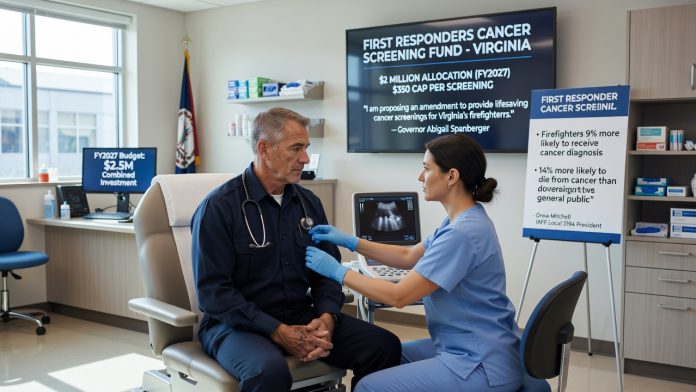
Virginia is set to significantly expand a critical health initiative for first responders in the upcoming fiscal year, carefully balancing the moral obligation to protect firefighters with the absolute need for fiscal responsibility. The proposed FY2027 budget includes a substantial $2 million allocation from the general fund to officially establish a statewide First Responders Cancer Screening Fund. Governor Abigail Spanberger recently announced the legislative initiative, explicitly stating, “I am proposing an amendment to provide lifesaving cancer screenings for Virginia’s firefighters.” While supporting those brave individuals who risk their lives is a fundamental conservative value, taxpayer advocates emphasize that this new spending must be tightly controlled to prevent bureaucratic waste and government overreach.
Firefighters face severe occupational hazards on a daily basis that extend far beyond the immediate, visible dangers of burning buildings and toxic smoke inhalation. Drew Mitchell, President of IAFF Local 3194, highlighted the stark medical reality by noting, “Firefighters are 9 percent more likely to receive a cancer diagnosis than the general public and 14 percent more likely to die from a cancer diagnosis than the general public.” This highly elevated risk undeniably justifies targeted health interventions from the state, provided the resulting programs are managed efficiently and without unnecessary administrative bloat. Ensuring that these taxpayer funds directly reach the local heroes who desperately need them is paramount to maintaining public trust in government spending and state-managed health initiatives.
Fiscal Prudence Through Early Detection
From a strictly financial perspective, early medical intervention serves as a highly effective mechanism for reducing massive long-term government liabilities. The newly formed grant program, which will be managed by the Department of Fire Programs and the Virginia Fire Services Board, prudently limits state reimbursements to a maximum of $350 per eligible screening test. Catching severe occupational illnesses early actively prevents massive workers’ compensation claims, expensive late-stage medical treatments, and costly disability pensions that ultimately fall squarely on the shoulders of hardworking taxpayers. Therefore, spending a highly regulated, small amount upfront on preventative diagnostics is a fundamentally fiscally conservative strategy that protects both the state budget and the invaluable lives of local heroes.
The newly proposed statewide initiative represents a massive structural expansion from previous localized efforts that were distinctly limited in both geographic scope and overall funding. During the prior budget cycles spanning FY2024 through FY2026, the state primarily funded a localized pilot program heavily concentrated in Northern Virginia at approximately $430,000 to $860,000 annually. The FY2027 budget dramatically increases this financial commitment by rolling out a sweeping $2 million annual grant program designed to reimburse localities across the entire Commonwealth of Virginia. Additionally, the budget strategically retains a specific $500,000 allocation in FY2027 exclusively for the Northern Virginia Firefighter Occupational Cancer Screening Pilot Program to ensure regional continuity.
Demanding Accountability and Preventing Waste
With millions of taxpayer dollars newly allocated to the First Responders Cancer Screening Fund, rigorous legislative oversight is absolutely essential to prevent outright fraud and systemic financial mismanagement. Budget Amendment Item 406 1h explicitly directs these funds pursuant to the passage of House Bill 393, requiring strict adherence to established legislative guidelines and financial guardrails. The Virginia Department of Health must collaborate closely with local fire service agencies to guarantee that every single grant dollar goes directly toward vital medical testing rather than wasteful administrative overhead. Conservative lawmakers are uniquely positioned to demand regular, comprehensive audits of this entire program to guarantee that localities are not overcharging the state or actively misusing the strict $350 per-screening financial cap.
Protecting the public purse requires a constant, unwavering vigilance against government overspending, even when the underlying cause is highly commendable and widely supported. While no true fiscal conservative wants to deny essential health services to the brave men and women who rush into burning buildings, writing a blank check is never an acceptable or sustainable governance strategy. The Department of Fire Programs must definitively prove that this $2.5 million combined investment actually delivers measurable health outcomes and produces legitimate long-term cost savings for the state. If the program fails to demonstrate operational efficiency and financial transparency, the General Assembly must be fully prepared to aggressively restructure the funding mechanism in future legislative sessions.
Ultimately, the Commonwealth of Virginia has a profound moral duty to support its dedicated first responders while simultaneously respecting the hardworking taxpayers who exclusively fund these community initiatives. By strictly capping the screening grants at $350 each, the state has successfully implemented a highly reasonable safeguard against exorbitant medical billing practices and corporate healthcare greed. As the FY2027 budget officially takes effect, conservative leaders will continue to closely monitor the First Responders Cancer Screening Fund to ensure it remains a shining model of financial efficiency. True conservative governance definitively proves that a state can fully honor its solemn commitment to local heroes without ever surrendering to unchecked government expansion, wasteful spending, or bureaucratic fraud.