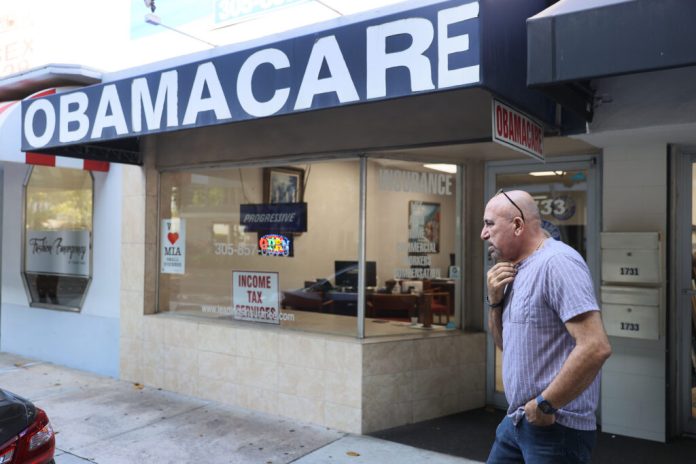
In 49 states, the number of people enrolled in Obamacare plans has declined since Congress made coverage more expensive by allowing federal subsidies to expire at the end of last year.
The lone exception was New Mexico, the only state that has used its own money to fully replace the expired aid, according to a new analysis by KFF, a health policy research group.
Late last month, the Trump administration announced that overall participation in the health insurance marketplaces created under Obamacare, officially called the Affordable Care Act, had declined by nearly 3 million people, to about 19.2 million from 21.8 million in 2025. That 2025 figure, the highest ever recorded, was the culmination of six years of steady increases.
In announcing the figures, the Trump administration blamed much of the growth since 2021 — the year former President Joe Biden took office — on “improper, phantom and fraudulent enrollment.” It said the number of people in those categories peaked at 5.6 million last year, and that this year’s decline was the result of its efforts to eliminate enrollees who misstated their income to gain access to free plans.
But KFF connected this year’s decline to the expiration of the enhanced federal subsidies. Designed as a temporary pandemic-era measure, the subsidies were made available by the American Rescue Plan Act in 2021 and later extended through the end of 2025 by the Inflation Reduction Act.
The enhanced subsidies were available to everyone, regardless of income. Additional federal aid provided to some of the lowest-income households entirely eliminated premium payments for some people. Congressional leaders let the subsidies expire on Dec. 31.
Under the Affordable Care Act, each state can either use the federal government’s online insurance marketplace, HealthCare.gov, or operate its own state-run exchange. In states with their own exchanges, including some that used their own money to partially replace the expired federal subsidies, the average enrollment drop was 6%, according to KFF. In states using the federal marketplace, the average decline was 15%.
Enrollment fell the most in Ohio and Oklahoma (32%), Arizona (30%), South Carolina (29%), Indiana (28%), Michigan and Minnesota (27%), and Louisiana and Mississippi (26%).
Enrollment in Connecticut, the District of Columbia, Idaho, Illinois, Massachusetts, Pennsylvania and Texas was flat or fell by less than 5%. In New Mexico, enrollment grew by 14%.
Justin Lo, a KFF senior researcher who co-authored the report, said in an email that the number of fraudulent enrollees in Obamacare is likely in the “hundreds of thousands,” rather than the millions. Higher estimates, he said, are based on “suspicious patterns that could be explained by fraud or by legitimate factors, the most notable of which is greater subsidies making coverage more affordable.”
“We had a huge growth in the marketplace uptake because a lot of people were seeing that they could now qualify for very cheap plans,” Lo said. “So now, when we’re looking at the loss…it’s people who had marketplace coverage now having to evaluate whether they want to continue it.”
The KFF report examined not just the number of people who enrolled in Obamacare plans this year compared with last year, but also how many maintained that coverage as the year went on. Many people, the group noted, enroll but then end up dropping coverage when they can’t make the first premium payment.
This year, Mississippi had the lowest rate of enrollees maintaining coverage past January, at around 61%, while South Carolina, Louisiana, Indiana and Oklahoma also had rates below 70%. In New Mexico, California, Nevada, Vermont, and Idaho — all states with their own marketplaces — at least 95% of enrollees kept their coverage.
Lo said it’s hard to predict how enrollment figures may look in a year, as some insurers that currently offer plans on the marketplaces “are reassessing their positions and their commitment” to participating.
“So, if insurers are pulling out, people who are seeking marketplace coverage might have fewer choices,” Lo said.
Obamacare insurers are proposing a median premium increase of 14% for 2027, which would be a double-digit hike for the second year in a row, according to a new analysis of preliminary rate filings. Rates should be finalized later this summer.
Stateline reporter Shalina Chatlani can be reached at schatlani@stateline.org.
This story was originally produced by Stateline, which is part of States Newsroom, a nonprofit news network which includes Virginia Mercury, and is supported by grants and a coalition of donors as a 501c(3) public charity.