
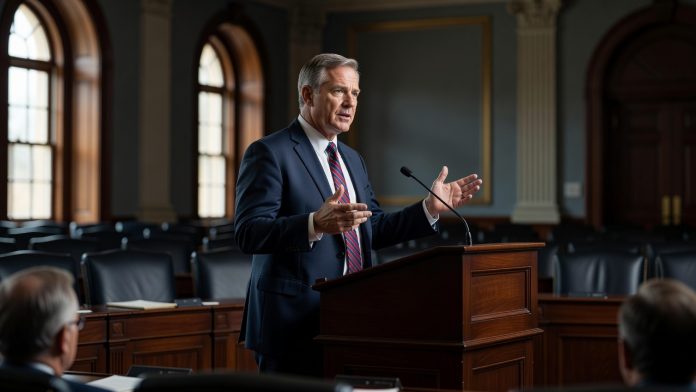
Senator Bill DeSteph spoke in the Virginia Senate about the role of regulations in business decisions affecting the state.
He referenced experiences from the 1990s and early periods when employers with over 600 employees considered locations in Virginia. The senator described how some of these companies ultimately selected other states for expansion.
DeSteph pointed to one instance involving a potential 750-employee project that went to Tennessee instead. He noted that Virginia did not secure the opportunity due to regulatory factors.
Details from the Senate Presentation
In his remarks, DeSteph outlined how government rules have accumulated and created challenges for employers. He mentioned that companies providing paid benefits faced additional requirements that influenced their choices.
The presentation included comparisons between Virginia and neighboring states to illustrate differing approaches. DeSteph stated that these differences affected where businesses decided to invest resources and create jobs.
Observers noted the focus on historical cases to support the discussion of current economic conditions in the commonwealth.
Examples Cited in the Address
DeSteph shared specific numbers from past business proposals to show patterns in location decisions. One case involved a firm with more than 600 employees that did not expand locally as initially considered.
Another example highlighted a 750-employee opportunity directed to Tennessee. The senator indicated that Virginia’s regulatory framework played a part in the outcome.
These references served as the basis for examining broader trends in how states attract or lose employers over time.
Implications for State Policy
The senator’s comments addressed the need to evaluate how regulations impact business competitiveness. He suggested that adjustments could help retain or attract similar projects in the future.
DeSteph expressed that successful employers contribute to overall state stability and employment levels. The discussion remained centered on factual examples from prior decades without proposing specific new measures.
Further review of state economic data could provide additional context on these trends.